Theory of Change
With our mission and vision being the guiding light for the organization, Friendship Bridge has worked to clearly define its Theory of Change, which we convey through the metaphor of a tree. Each tree represents the two distinct client segments we serve. The roots are the products and services (or interventions), and the leaves are the outcomes we expect to achieve. Click here to learn more about our approach.
Friendship Bridge continuously monitors and evaluates our achievement toward these objectives. Friendship Bridge has a Monitoring, Evaluation, and Learning (MEL) framework and system to provide regular insights into how programs are working and critical information regarding our progress against our social objectives and keeps the organization client-centric and mission-driven. Our approach is to use a combination of industry-standard tools for benchmarking, internal tools for program insights, and third-party evaluations to have robust and reliable information.
Clients consider that Friendship Bridge has significantly contributed to their improved quality of life (97%), their ability to make financial decisions (93%), and their increased income (93%) among other outcomes, earning Friendship Bridge the recognition as a Top Performer in Latin America, according to 2023 60_Decibels Microfinance Index.
2021–2025 Strategic Plan Outcomes
Our 2021–2025 Strategic Plan, Impact2, set out to deepen our impact across two distinct client segments—Dreamers and Entrepreneurs—by strengthening our Microcredit Plus model and launching the Bridge to Success program, serving women ready to grow their businesses and create jobs in their communities.
The results affirm that our approach is working. Dreamer clients are meaningfully less poor, more financially confident, and making more decisions for themselves and their families. Entrepreneur clients in Bridge to Success are growing their profits, increasing their income, and creating jobs that reach beyond their own households.
Impact Management
At Friendship Bridge, impact is not a byproduct—it drives every decision. As we implement our 2026–2030 Strategic Plan, we are strengthening our approach to Impact Measurement and Management (IMM) to ensure that growth consistently translates into meaningful change for the women we serve. We use a combination of globally recognized methodologies and proprietary tools to track client progress, understand drivers of change, and continuously improve our programs.
IMM is embedded across our model: we set clear goals, measure performance, and use data to continuously improve outcomes:
- Our work is guided by global best practices, including the CERISE+SPTF, which place client well-being, protection, and resilience at the center of operations.
- Data is regularly reviewed by leadership to refine product design, adjust service delivery, strengthen client protection practices, and improve operational efficiency.
- Insights also inform staff training, incentives, and resource allocation, which ensures alignment between day-to-day execution and long-term impact goals.
Our Commitment Demonstrated
- Annual SPI social audits consistently achieving Excellent results, particularly in Social Strategy, Committed Leadership, and Client-Centered Products and Services.
- Certification by Great Place to Work® in Central America and the Caribbean for six consecutive years, and recognition as one of the Best Places to Work™ in Guatemala 2024.
- Recognition as one of the Best Workplaces for Women™ in the Caribbean and Central America (three-time honoree).
- Top performer status in the 60 Decibels Microfinance Index (2023), ranking among the best in Latin America in access, business impact, client protection, and resilience, and recognized as a top performer in outreach to women (2025).
- Verified member of the Fair Trade Federation, with our Handmade by Friendship Bridge® program upholding fair pay, respect for cultural identity, safe and empowering working conditions, targeted business training, and expanded market access.
How We Mange and Strengthen Outcomes
- Social performance dashboards and KPIs, aligned with IMM principles, to track both outputs (e.g., outreach, retention) and outcomes (e.g., resilience, business growth, empowerment).
- Regular client surveys and feedback loops, including onboarding, cycle-based check-ins, and complaint mechanisms- to monitor client experience and identify risks early.
- Poverty Stoplight (developed by Fundación Paraguaya), to measure multidimensional poverty (developed by Oxford) and track annual changes in client well-being, enabling targeted support and segmentation.
- Client Advisory Committee, to engage with clients elected to represent their geographic areas to appropriately design and approve services.
Friendship Bridge has long been committed to upholding the Client Protection Standards, an industry standard of “do no harm”:
- Appropriate Product Design and Delivery: Providers will take adequate care to design products and delivery channels that do not cause clients harm. Products and delivery channels will be designed with client characteristics taken into account.
- Prevention of Over-indebtedness: Providers will take adequate care in all phases of their credit process to determine that clients have the capacity to repay without becoming over-indebted.
- Transparency: Providers will communicate clear, sufficient, and timely information in a manner and language clients can understand so that clients can make informed decisions.
- Responsible Pricing: Pricing, terms, and conditions will be set in a way that is affordable to clients while allowing for financial institutions to be sustainable.
- Fair and Respectful Treatment of Clients: Providers will treat their clients fairly and respectfully. They will not discriminate. Providers will ensure adequate safeguards to detect and correct corruption and abusive treatment.
- Privacy of Client Data: The privacy of individual client data will be respected in accordance with local laws and regulations, and client data will only be used for purposes specified when the information is collected, unless otherwise agreed with the client.
- Mechanisms for Complaint Resolution: Providers will have in place timely and responsive mechanisms for complaints and problem resolution for their clients and will use them.
- Governance and Management are Committed to Client Protection: Leadership and management practices internal systems that are committed to protecting clients.
We not only incorporate the Standards within our practices, but we also work to promote the practices in the industry through its active membership in local industry networks such as REDIMIF, a Guatemalan association of microfinance institutions and a member of the industry task force. By these activities, Friendship Bridge is continuously shaping and improving its knowledge of social impact.
Friendship Bridge supports the UN Sustainable Development Goals, which aim to promote prosperity by ending poverty, building economic growth, addressing social needs, and protecting the planet across all countries worldwide.
- 1. No Poverty: We provide microcredit to women living in poverty so they can invest in their small businesses and create jobs in their communities. The majority of our new clients are living in poverty, with daily income ranging between $1.11 to $4.49 per day. However, after their third loan cycle with Friendship Bridge, the rate drops by about 5%, and the trend continues downward the longer they are in our programs.
- 3. Good Health and Well-Being: Our Health for Life program brings preventive healthcare directly to clients, reducing premature mortality from non-communicable diseases like hypertension and diabetes. Our program also provides education and access to comprehensive women’s health services, ensuring women in even the most remote communities receive high-quality, last-mile healthcare services.
- 4. Quality Education: We provide our clients with the educational means necessary to become successful business entrepreneurs in a country marked by one of the highest disparities between rich and poor in Latin America. By focusing on education in addition to microcredit, our clients have the opportunity to share gained skills with family, friends, and community members, creating a ripple effect of empowerment.
- 5. Gender Equality: Our products and services are exclusively tailored for women, designed to meet their unique needs and preferences. To deliver the most appropriate programs, we actively listen to clients. We prioritize gender equality within our staff and governance; in 2025, 65% of promotions were granted to women, including 50% of executive leadership roles and 65% of seats on the Board of Directors.
- 8. Decent Work and Economic Growth: After participating in the Bridge to Success program for more than one year, clients have doubled their profits and sales, on average. Through December 2025, 15% of clients have created paid jobs as a result of their participation in the program.
- 10. Reduced Inequalities: We deliberately target marginalized populations, including Indigenous Maya women in rural Guatemala, contributing to sustained income growth among the poorest 40% of the population. Additionally, we promote equitable employment practices, ensuring these standards of equality are reflected in our internal operations.
- 12. Responsible Consumption and Production: Through Non-Formal Education, we teach clients sustainable waste management practices they can apply in their homes and businesses, from reducing waste to reusing materials in different ways. By practicing “reduce, reuse, and recycle” principles ourselves, Friendship Bridge integrates this commitment to responsible consumption in our day-to-day work.
- 17. Partnerships for the Goals: We mobilize additional funding for a developing country by fundraising internationally and investing directly in Guatemalan communities. Additionally, we contribute to Guatemalan exports through our Handmade by Friendship Bridge® program, connecting artisans to global markets.
The content of this publication has not been approved by the United Nations and does not reflect the views of the United Nations or its officials or Member States.
Poverty Stoplight is a poverty elimination methodology based upon the Multi-Dimensional Poverty Index developed by UNDP and Oxford and developed by Fundación Paraguaya to help clients holistically assess their living conditions and quality of life in order for them to identify concrete actions for improvement.
How it Works
- Clients self-assess 31 quality of life indicators (such as Savings, Waste Management, Unforeseen Events, etc.)
- Clients assign a rating to each indicator: green (an acceptable condition), yellow (a condition in need of improvement), and red (an unacceptable condition).
- After completing the survey, clients receive a Life Map, helping them see a broad view of their current conditions, identify their priorities, and set goals.
- Throughout the year, Friendship Bridge checks in with clients on the progress of their goals.
- A year later, Friendship Bridge conducts a follow-up survey with clients to reassess the same indicators to evaluate for change.
Using the Poverty Stoplight methodology over the past four years, we saw a 27% poverty reduction rate among our clients from 2021 to 2025. This was measured based on indicators that reflect progress in areas including income, savings, and economic stability.
Additionally, from 2021 to 2025, clients improved their living conditions by an average of nearly 9% annually.
Friendship Bridge ranked among the top 20% of peer institutions globally for Female Reach 2023–2025 and received a 2025 Social Impact Award, based on results from 60 Decibels’ 2025 Microfinance Index, the global impact measurement company.
In a competitive microfinance industry where some lenders prioritize profit and weaken client protections, 100% of our clients in the sample survey conducted by 60 Decibels reported “no harassment, unfair treatment, or unwanted pressure” by Friendship Bridge staff.
In addition, clients surveyed report the following:
- 89% say their loan repayments are not burdensome
- 57% report increased income
- 44% can now afford household bills
- 36% say their businesses have grown
- <1% indicate challenges with the organization
- 26% report “very much decreased time spent thinking about finances”
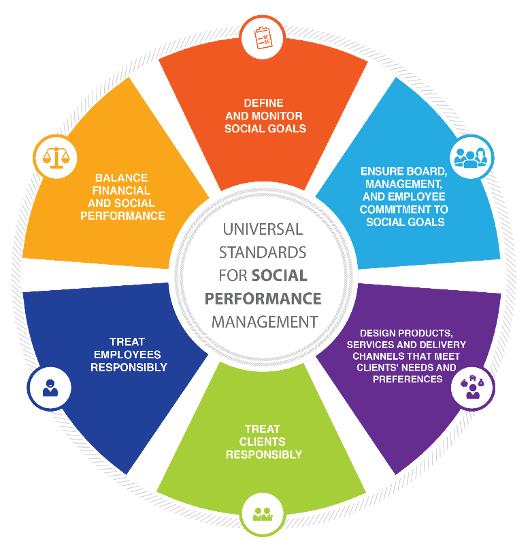
To balance social performance with financial performance and to increase the likelihood of achieving our mission, Friendship Bridge utilizes the Universal Standards for Social Performance Management (see left).
Source: https://sptf.info/universal-standards-for-spm/universal-standards
Social Performance Standards, Awards, and Recognition
- Received a Top Impact 2023 Award for access, business impact, client protection, and resilience in Latin America from the microfinance index report by 60_Decibels.
- In a 2022 social audit using the Cerise SPI4 (assisted self-assessment), our compliance score with the Universal Standards and practices was 82 compared to a global average of 61 (out of 100).
- Friendship Bridge provides quality employment in rural areas of Guatemala and was certified as #1 Best Place to Work® for Women in Central America and the Caribbean 2022-2023, as well as a Great Place to Work® in 2019, 2021, and 2022.
- Friendship Bridge works to ensure a high level of compliance with the Client Protection Standards and we promote the practices in the industry within Guatemala, particularly in relation to preventing over-indebtedness.
- Kiva has awarded Friendship Bridge 5 (of 7) Social Performance Badges: Client Voice, Anti-Poverty Focus, Vulnerable Group Focus, Entrepreneurial Support, Family and Community Empowerment
- Friendship Bridge was recognized at Leader status by Truelift in 2017.
- For three consecutive years, Friendship Bridge has had a winning client in Citi Bank’s Microentrepreneurship Awards Program. See our most recent client, Jacinta, in this video.
Your support makes these results possible.
The data on this page represents real women in Guatemala working their way out of poverty for themselves, their families, and their communities. Help us keep measuring, and growing, our impact.